

services
Physical AI
and Humanoid Robotics
Physical AI enables next-generation machines, industrial systems and robots to perceive their surrounding environment, determine the most effective way to execute assigned tasks, and act autonomously in the physical world.
Why now
Greater Productivity and Safety Across Every Sector
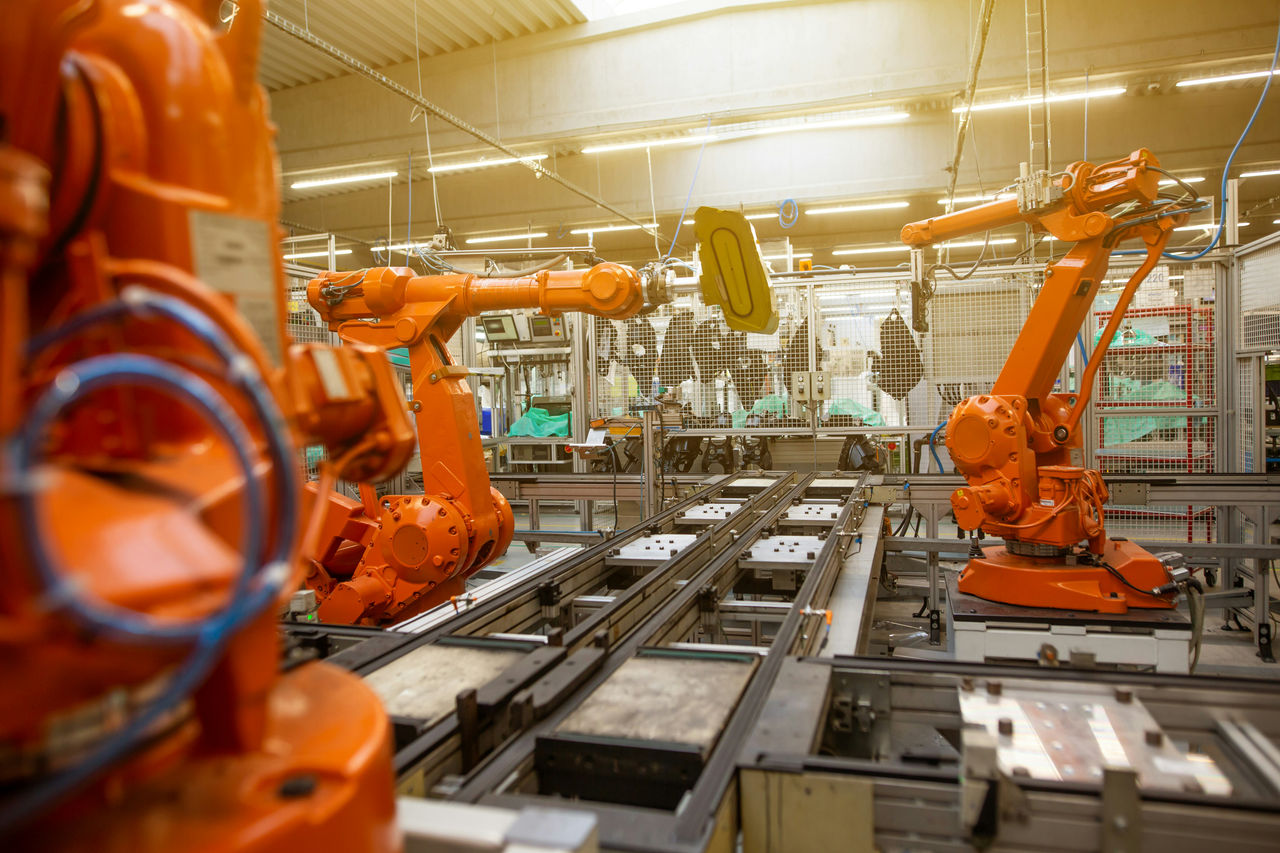
Italian businesses and public institutions must ensure productivity, safety, and service continuity in an environment defined by intense competition and the need to rapidly develop new skills to keep pace with technological change. Physical AI provides a tangible response to these challenges by enabling next-generation robots to take on repetitive, physically demanding, and potentially hazardous tasks, freeing valuable human resources to focus on higher-value activities that require greater responsibility, expertise, and decision-making capabilities.
Where it applies
Application Areas: From Manufacturing to Energy & Utilities and Beyond
Physical AI and Humanoid Robotics can be deployed across all industries where value is created through physical operations and activities.
Manufacturing, Retail and Construction
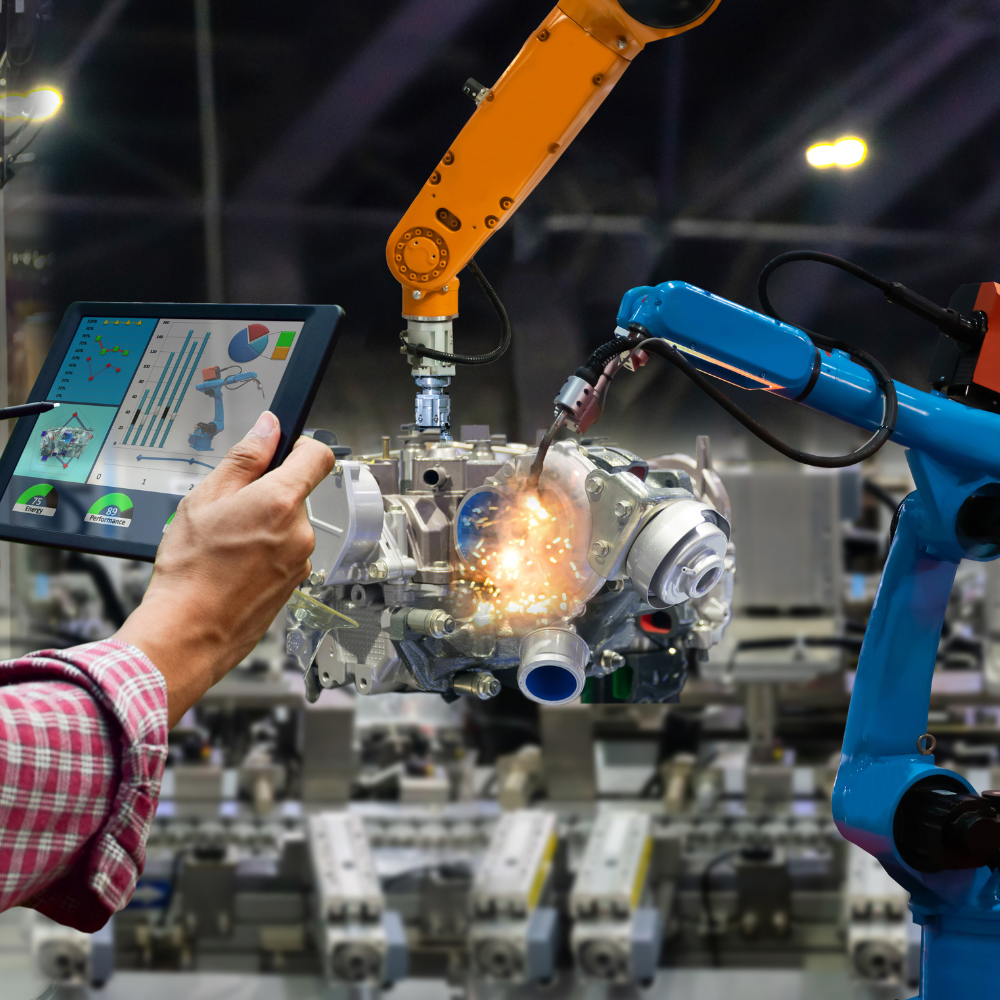
These are the sectors where Physical AI and robotics solutions find the broadest range of applications: robots work alongside people in repetitive, physically demanding, monotonous, and potentially hazardous tasks.
- Smart Intralogistics: material handling, line feeding, warehouse operations, and pallet transport.
- AI-Powered Quality Inspection: quality control, code reading, defect detection, and packaging verification.
- Autonomous Production Cells: assembly, pick-and-place operations, automated testing, and machine tending.
Energy, Utilities and Infrastructure
Industrial facilities and networks require frequent inspections in hard-to-reach areas: robots perform them with continuity and precision, providing data for predictive maintenance.
- Asset and Facility Inspection: industrial plants, Energy & Utilities assets, oil & gas facilities, and other complex infrastructures.
- Electrical Substations, Power Cabinets, Tunnels and Construction Sites: routine inspections using cameras and thermal sensors in hazardous environments.
- Digital Twins for Critical Networks and Systems: monitoring, analytics, and simulation to anticipate operational issues before they occur.
Public Administration, Safety and Emergency Response
Robots can be the first to enter hostile environments, identify hazards and critical issues, and reduce direct human exposure to risk. Pilot programs and deployments are already underway across Italy and Europe.
- Reconnaissance in Hazardous Environments: ground and quadruped robots supporting emergency response and civil protection operations, particularly valuable in low-visibility conditions, smoke-filled environments, high-temperature areas, and situations involving the risk of structural collapse.
- Chemical, Biological, Radiological and Nuclear (CBRN) Emergencies: robots and drones operating safely in contaminated areas.
- Public Safety and Space Monitoring: environmental surveillance and AI powered video analytics.

L.U.C.A., Lutech’s First Humanoid Robot
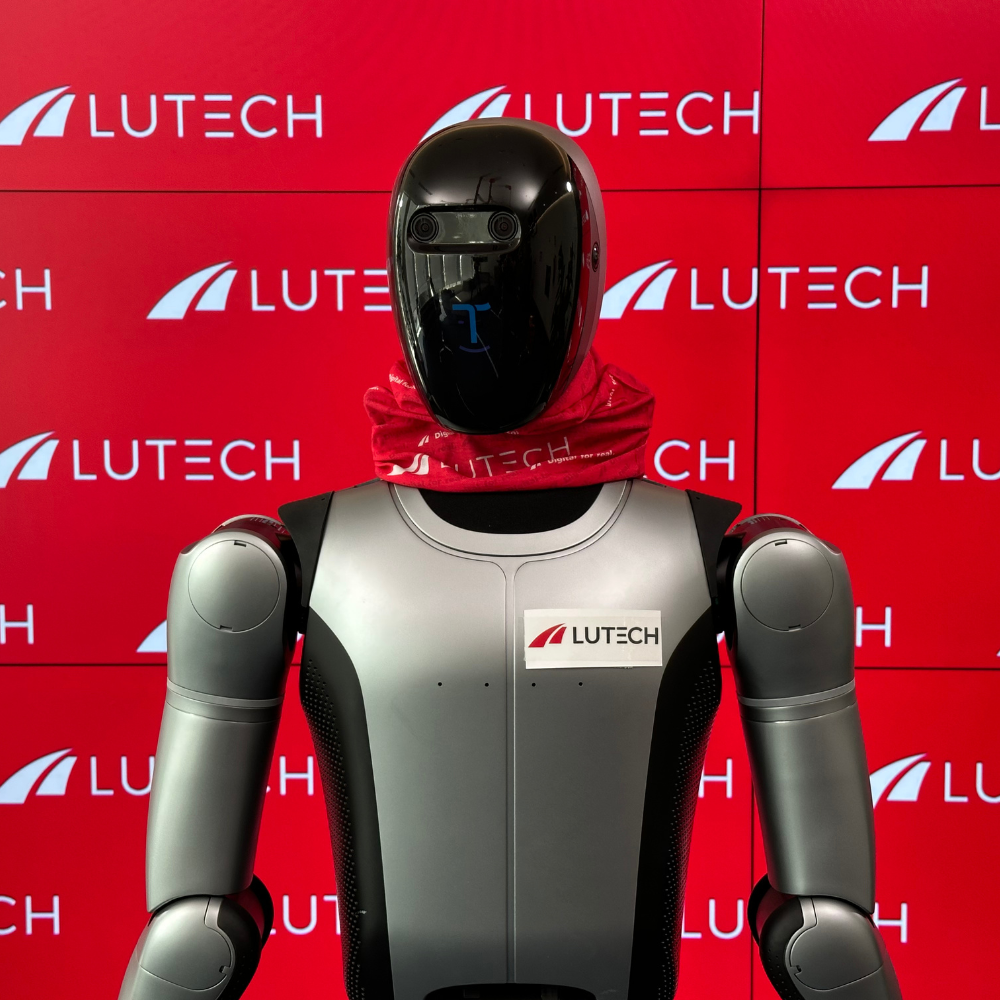
L.U.C.A. (Lutech hUmanoid Collaborative Assistant) brings human-robot collaboration into enterprises and public-sector organizations. Designed as a versatile collaborative platform, it learns and performs tasks currently carried out by people, supporting operators while allowing them to focus on higher-value activities: L.u.c.a. has already been deployed in specific operational use cases, including:
- Material handling and transportation
- Factory safety inspections and monitoring
- Physically demanding and repetitive tasks that place a high strain on workers
To accelerate its adoption, Lutech has developed a program to customize L.u.c.a. for different use cases, enabling organizations to experience firsthand the benefits it can bring to their own processes.
From Use Case Identification to Day-to-Day Operations
Lutech’s approach covers the entire lifecycle of a robotics and Physical AI solution, helping organizations move beyond the Proof of Concept stage with solutions that are manageable, secure, and scalable. The journey is structured in three phases, each delivering tangible outcomes to be validated before progressing to the next.
1. Advisory and Assessment
Everything starts with the organization’s processes: strategy is defined, activities are mapped, and use cases with the best balance between value and feasibility are identified.
- Process mapping and identification of priority use cases.
- Technical and operational feasibility assessment: spaces, workflows, and integration with existing systems
- Business case development: TCO and ROI evaluation to determine whether and how to launch a pilot project.
2. Engineering, Simulation and Integration
The solution architecture is defined, robots are trained, and scenarios are validated in the Digital Twin before deployment in the field. Three elements support this phase from the outset:
- Simulation-based training. The environment is recreated in a virtual setting with robots and objects, and high-quality demonstrations are collected through teleoperation. The data is augmented using generative models and synthetic data for large-scale training. The solution is then transferred to the physical robot for validation under real-world conditions. The results are fed back into the cycle to improve performance.
- Functional safety. Safety is designed into every phase, from hardware to AI models. A dedicated operating system takes priority over any AI operation and stops the robot when an obstacle or collision risk is detected. AI models are isolated from critical functions and are restricted or shut down in the event of anomalous behaviour. An edge AI platform, connected to cameras and sensors deployed in the environment, alerts the robot to obstacles that are not yet within its field of view. In the event of a partial failure, the robot compensates by recalculating its trajectory; in the event of a critical failure, it switches to fail-safe mode, executing a controlled descent to protect nearby people.
- Orchestration. A centralized platform coordinates robots, people and machines: it assigns missions, manages routes and traffic, correlates data from cameras and sensors to update fleet behaviour in real time, and automatically intervenes when an issue is detected. It integrates with the organization's information systems.
3. Managed Services and Robot-as-a-Service
Once deployed, Lutech manages the robotic fleet over time through:
- Remote monitoring and management of each robot's status;
- Planned maintenance and performance analysis;
- Continuous software and model updates;
- Fleet expansion and optimization as use cases grow.
All of this is also available through a Robot-as-a-Service (RaaS) model: a recurring subscription that includes robots, Industrial AI powered by Lutech BrAIn, simulation with NVIDIA Omniverse, and end-to-end managed services. It enables organizations to start their automation journey without a significant upfront investment and ensures operational availability, technology updates, and continuous improvement.
Expertise, Sovereignty and Ecosystem
At the foundation is Lutech's experience in the Digital Thread and Digital Twin, which connect data, models and processes from design through to operations. Lutech can rely on more than 600 professionals with Industrial and Engineering expertise. For public-sector organizations and operators of critical infrastructure, data and models remain under control on a sovereign AI infrastructure, Lutech's Secure AI Factory.
- Technology partners: NVIDIA, PTC, BI-REX and Infor, for lifecycle management, simulation, training, and the orchestration of logistics and production.
- Demo Center: a space to test and validate use cases from idea to pilot and through to scale, with applications in collaborative robotics, Digital Twins for critical systems, and intelligent video analytics.
Evaluate Robotics and Physical AI on Your Processes and Infrastructure
We start from a concrete use case and your work environment. Together with our team, we assess feasibility and return on investment, and in manufacturing, through the L.u.c.a. customization program, you can see the benefits on your production process firsthand.
We invite you to read the marketing policy disclaimer.
Digital Services for your future
.
Strategic consulting for the transformation and innovation of your business models
Consulting services on Cloud Transformation paths: Legal, Governance and Compliance Consulting
We design, implement, secure and manage Hybrid Cloud Technologies Solutions
We guide you in the transition to the Cloud, with the support of the best Partners and our Consultants
What is a hybrid cloud and when to choose a hybrid cloud solution?
Solutions to improve performance and security of Database and enterprise application ecosystem
Unified Communication and Collaboration, Document Management and Workflow Management Solutions
Design, installation and management of IT infrastructure and Next Gen Networking for Data Center Modernization
Solutions to protect your network, users and endpoints from cyber threats
Consulting, design, audits and education to best defend your data, your assets and your people
Web projects to improve the customer experience: UI/UX, CMS Enterprise and Digital Marketing Consulting
Application modernization, from development to performance monitoring, with DevOps and low-code approach
We build predictive models and automate repetitive processes to optimize your business
Digital catalog, B2X ecommerce and CPQ solution to reach new markets and customers
Customer engagement and cross selling strategies
We manage the entire data lifecycle to improve your decision-making processes
Solutions to improve online sales and drive-to-store, for a unified commerce experience
Digital Transformation Consulting and Delivery of Customer Engagement projects in Customer Engagement, Omnichannel Commerce, B2B eCommerce, Big Data & AI fields
From Smart Factory to Smart Connected Products, we turn data into value for your business
Learn more >We drive digital transformation projects for the manufacturing world to extract maximum value from data
We implement projects to optimize the management of the entire product life cycle for Industry 4.0
IoT and Smart Manufacturing consulting pathways in data management to improve performance
Expand business value and improve performance through Smart Connected Products
How to improve the sustainability of cities and the quality of life of citizens thanks to Digital Twin
24/7 Managed Services, always-on enterprise ecosystems in hybrid multi-vendor environments
Solutions for the optimal management of Energy Management processes
Banking & Finance Solutions, capital markets and wealth management
Development of proprietary software solutions and RFID hardware components
Building “digital twins” for companies for a more competitive, efficient and inclusive society
Benefits and impacts of HPC for business, research and territories
Managing complex problems to improve business processes and create innovative and sustainable products and services
Break down the barriers between IT and OT, process data faster and improve the customer experience
An open, inclusive platform for everyone for an immersive evolution of the web
Lutech Group's hub of excellence for digital transformation
Catalyst for innovation, booster for human creativity and accelerator of automation processes
End-to-end services aimed at Telco and Enterprise operators with scope of expertise on network technologies
Management services for traditional data center infrastructure and public cloud provider resources
Adopt a flexible, modular and secure work solution that can be used on any device and workplace
The business platform that enables you to accelerate your company's innovation
End-to-end ERP projects to achieve process innovation and supply chain customization in manufacturing with INFOR Ln
ERP for superior operational efficiency and revolutionary customer experiences
Physical AI and Humanoid Robotics: From the Factory Floor to the Nation’s Critical Infrastructure.